Robot Wars: Stopping Counting Views on Experience Reports

Greetings! As of today, October 8, 2025, we have decided to stop counting and displaying “views” on experience reports.

The time to do this passed years back, but we just hadn’t removed the software or database tables. But, as described in previous posts about robot wars just outside most people’s perception, the number of robot hits to the site exceeded the number of human hits around 20 years go and the ratio is now more like 1000 to 1 robot hits to human hits.

Many robots now regularly misidentify themselves as being human-controlled, and beyond adding outlandishly annoying CAPTCHA-type human-detectors or other stupid interferences such as pushing all traffic through CloudFlare or similar monstrosities, there really is no practical way to tell human traffic from robot-spiders pretending to be human.

So, as of today, we will continue to collect generalized logs of web traffic for analysis that will include Experience Report views, but will stop displaying or attempting to record human views of Experience Reports. We now think they are pointless and probably worse than that: misleading.

Ah, the age of crappy software. Thanks to the humans and good robots. The tiny minority that you are :]

— earth

Robot Wars Just Outside Most People’s Perception: Bad Software LLM Edition

Around 2004, Erowid.org hit the human-robot inflection point: the number of robot / bot / script “hits” to our websites exceeded the number of human visitor hits. By 2014, the numbers were more like 10x robot to human. In 2025, it’s 1000x robots to humans.

There are a lot of complications in describing this. Many of the “good actors” are search engines. Google scrapes our entire site every day, as does Bing. Yahoo bot every couple days. They are not actually good robot actors anymore, they steal content from sites they scrape, such as erowid, then publish it on their own websites without giving us credit or a link back. But those are the “good” robots. They are horrible mega corp thieves, but at least they don’t disable our servers.

There is also the ridiculous joke that the current LLMs can be trusted to serve up medical information to the public that they’ve “synthesized” from the web. So even the “best” LLM robot scrapers are doing the public a disservice, damaging our services, and making original-content sites like erowid (and many others) less relevant.

There are other good bot spiders who limit their rates and don’t create insane parameter abuse. Parameters are things added to a URL after a question mark or a slash that can send additional data to the server or request extra actions or responses. On erowid.org, our Experience Vaults are mostly parameter driven. The difference between https://erowid.org/experience/exp.cgi and https://erowid.org/experience/exp.cgi?Y1=2025 is that the the second url adds a name-value pair called a parameter.

Many web servers, such as our Apache (praise Holey Apache) also accept parameters through slashes. Erowid handles slash params in some of our software, but not most. It gets pretty technical and I’m not trying to bore those who don’t write server code or those who do.

For instance, humans and googlebot hit donations.php. Bad bots try donations.php with ten thousand different question mark parameters to try to see if the page is a WordPress entry or some other known piece of software that might have a published bug. Or insert “XSS” (cross site scripting) to see if they can create a URL they could spam out where it would appear to be a valid erowid URL, but would do something malicious. They are trying to find security holes to exploit to break into our site. Or they are just trying to overwhelm our server with useless hits. We have spent decades hardening erowid against such attacks, but Real Security Is Real Hard. There is no end to fighting against attack robots.

In the era of “cloud computing”, where many people can rent virtual server space that goes almost unmonitored by those who rent it out, people who used to badly run archiving spiders can now inflict an army of bad spiders out at the same time.

I spend hours every day on our “shields”, but the attacks are absurd.

Good robot-spiders behave nicely. They honor robots.txt exclusion files and they report who they are and what they’re doing accurately. Bad robots (now 99.9% of robots) lie about their identity and their purpose. And Amazon and Google and other virtual-server hosts now allow evil robots to run on their platforms that lie that they are amazonbot, googlebot, bingbot, etc etc etc.

Another common type are home human users who want to make a copy of Erowid.org but don’t understand how to run their robots properly and don’t understand the sheer number of humans wanting to make home copies of our site(s). Thousands of humans per day set up an offline downloader and then just assume their software will work properly. Instead, those badly-coded bots usually run out of control and hit servers at 5-50 times a second. Multiply that times a thousand.

And then there are researchers who want to analyze the data on our site and disregard our Terms of Use and copyrights. They are not tech experts and they often run robot spiders that they don’t understand and often hit our site ten times too fast and ten times too much. Erowid has a little over 100 thousand unique pages but often these “research” bots will download a million or five million pages because they make errors with parameters that generate “unique” URLs.

Le Sigh.

New Server Robot Attack Threat: Garbage LLM-AI

But there’s another “new”-ish group of robots that are part of the “Artificial Intelligence” (AI) swarm that is so popular in public media. and part of a self-recursive funding crime machinery that seems to get more adopters every day. I [earth], don’t understand the absurd focus on new large language model (LLM) AI. We used to just call this shit “bad software”. WTF.  I can’t listen to the radio for five minutes without hearing the term “AI” as if the whole house of cards isn’t built on theft and absurd energy use being used against the general population and hurting every content producer who has less than a billion dollars. It’s a giant grift built on a stupid scam.

I grew up in the 1970s and our family were very early adopters of computers. I learned to type before I learned to write in cursive. I learned to solder green board, caps, and transistors before I knew how to break into online servers. But I was childishly black-hat hacking by age 8. Minor stuff: getting accounts on restricted systems so we could play games (“Adventure” par example). I stopped that type of thing when one of my older compatriots got raided by the FBI and spent time in jail. We got some calls to our parents telling them we had broken into a few systems and we stopped. But I digress.

We had crappy computers but we had great terminals (“Glass Terminals”, “Glass Boxes”) : machines with no computing ability except they had modems that could connect to remote servers. In our neighborhoods and schools, there were various computers here and there, but very few computers had network connections and almost none had standardized data media. What I’m saying is that each computer was alone, isolated, and you couldn’t reliably add software to it. There were several companies that had home computers in the late 1970s that had tape drives and a few that had 5-inch floppy disk drives, but most home computers had no standard read-write media at all. It was insane. That changed around 1979 to 1982, to digress further.

So, as a computer kid who understood parlor tricks, the pillars of magic, typing, and computers, I memorized many programs in BASIC, which was an almost ubiquitous programming language across most home or school platforms. My favorites were Animals and Twenty Questions, but one of the 60-ish line programs I memorized was ELIZA. It was a trivially simple prompt that pretended to be a human therapist on the other end of an invisible network connection. I would usually type the program in and fiddle with people’s computers and then say, “Oh, I got it connected to the net and logged in to a psychotherapist, sit down and ask it questions.”

It was ridiculously simple. If I was stuck in the house for a long time with nothing else to do, I could customize it and add a few hundred lines to make it way more complex. If I knew the target rube, I would add in a few extra lines to target them. After a few dozen trials, I knew the most common questions people would ask. It was easy to add extra “smarts” to ELIZA. But even using the non-customized BASIC code, far over 50% of the people who sat down and chatted with ELIZA initially thought it was a human on the other end, despite their computers not having any networking capabilities and the very thin depth of ELIZA. Most people would figure out it was crappy software after 10+ questions, but the initial effect was exactly what I wanted. Many owners and schools with early home computers were totally fooled by the trivial set of ELIZA rules for software and a text prompt that would simulate a caring, interested therapist.  So now, what does my tricking people with ELIZA in 1977 have to do with today?

The grifter shadow box magic trick that is currently called Artificial Intelligence. Why is AI relevant to the blizzard of robot wars? Because the companies making these “AI” systems rent or sell the software to almost anyone and they can and are used to “ingest” data from websites.

2025 LLM “Artificial Intelligence” Monsters

So here we are in September 2025 and the majority of bad actor spider robots attacking erowid appear to be LLM monsters. Why did I tell the story about memorizing ELIZA? Because the dumb, grifter, magic trick bullshit that was ELIZA is exactly the same as the current “AI” garbage. The AI bots have stolen all of the content online, they ignored rules of use, copyrights, and our technical robot-to-robot rule settings. And they are so badly written that their authors can’t keep them from encouraging people to commit suicide. And that’s when the AI is run by the legitimate companies.

To re-iterate: the crappy AI and their theft machines are the responsible LLM AI bots, where some major company’s name is attached to their horror show.  But now major companies give or license out their horrible software to anyone for any purpose. They do not get better when they are directly controlled by anonymous people with no repercussions possible other than maybe having one of their virtual servers disabled. But getting that to happen is very, very difficult for someone being violated by their malicious bots.

And they aren’t just making worse ELIZAs, one “new” purpose is to attack websites like ours.  Hilarious.

For the last six weeks, we have had tens of thousands of IP addresses attacking our sites with fake “User Agent” info pulling info into LLM “AI” models. We can tell by what URLs they try and what url parameters they add on whether they are probing for security holes.

So this “new” addition to the blizzard of robot wars just outside people’s perception is LLM-type “learning” Artificial Intelligence robots that are programmed to attack and penetrate sites while also stealing the data and incorporating the good and bad data into their many, many databases controlled by nobody-knows-who.

I have not seen this specific issue covered in any other media, so I thought it was worth writing about. If you’re a unix nerd (which you likely are not) these robots have been forcing the “load” on our main public facing servers up over 50 with a near constant 5-20 load. We try to keep our load under 1 (one) as a rule. 50 load is very very bad. In UNIX server terminology, the load is the number of requests waiting to run. Our main machine has 16 CPUs each with a large amount of memory and each CPU can handle a process and most processes are completed in a hundredth of a second or so.

So, a new front in the robot war is LLM “AI” software that’s been re-coded to run as penetration testing, denial of service attacks, and just out of control machinery no one is paying any attention to except on our end where they have made it impossible, for instance, to serve our book review section because it’s been targeted for penetration.

Their hosting companies love these bad actors because they pay for their energy and network use. Amazon AWS appears to not care at all that their servers are being used as the largest digital weapon platform ever seen. Great job, Jeff Bezos.

If I enable book reviews, we get 500 hits per second, all with improper penetration parameters. It triggers red flags with our server farms and it causes a crazy weird set of problems that are probably better in a separate whining post. I will whine further in a separate article.

With love and respect for our human users: I apologize that I’ve had to block tens of thousands of IPs in the last month and shut down parts of the site, and stop and restart our web server multiple times per day for weeks.

Our main server had literally been online (“uptime”) for ten years before we had to move it in April 2024 to a new server farm (in the same ISP we’ve been using for 25 years). We try for 99.9% service uptime, but we can’t currently meet that target because of the:

Robot Wars Just Outside Most People’s Perception

My best to y’all and those you care about,

earth

Technical Director and Co-founder, Erowid Center
Erowid.org | DrugsData.org

Tim Scully Names Erowid Center as Literary Executor: The Underground LSD Manufacturing History Project

Former LSD chemist and historian of underground LSD manufacturing, Tim Scully — best known for his involvement in the legendary Orange Sunshine-branded LSD tablets in the 1960s — has named Erowid Center as his literary executor. We’re moving his history project ahead in exciting ways.

The Underground LSD Manufacturing History Project (ULSDMHP — needs a better acronym!) is a collection of documents and info gathered, cross-linked, and annotated by Tim with extensive references. It includes audio interviews conducted over the decades after his arrest and incarceration for LSD production. The custom database Tim designed has recently been transitioned to run on up-to-date software while Tim continues to edit and build out the data. Erowid Center is building out a new server setup to launch unembargoed data as a wiki, mirroring Tim’s database.
The following text by Tim Scully describes a little about why he’s put so much time into the Underground LSD Manufacturing History Project and his decision to formally make Erowid Center his literary executor, assigning us responsibility for the project upon his death. It ends with a PDF example of one of the thousands of documents collected by Scully for this project. Every blue, underlined word or phrase would be a link to another document or source material in the collection; we’ve removed the links because they don’t work outside of Tim’s unpublished collection. It gives a sense of how deep a dive he’s doing into the topics and people.

Project Background

by Tim Scully, Sep 25, 2025
Over 25 years ago when Bear Stanley, Melissa Cargill, Don Douglas, and I were exchanging stories about our time in the LSD underground, during an attempt at organizing a film project that never came to fruition, I had an idea. It occurred to me that it would be very interesting to find out what had happened to all of the people I had been involved with back in the 1960s when I was making LSD, and that it would be a nice idea to try to collect and preserve their stories.
I set out to interview some of my friends and associates from the old days. I decided that I was not interested in learning anything about possible recent activities: recent as defined by anything taking place within the statute of limitations, to put it gently. With five felony convictions already on the books, I have had absolutely no desire whatsoever to become involved in any way in further illegal activity of any kind.
But I was interested in uncovering “ancient history”, and the project expanded into the general history of underground LSD manufacturing.

I soon found out that people’s memories often conflicted, that they frequently recalled vivid mental images and stories but often were not able to anchor them in time to a specific date or even a year in many cases. I decided to collect the disparate stories. In an effort to anchor them in space and time, I also began assembling correspondence, press clippings, court records, reports of investigation and any other contemporary documents that would help me in connecting the puzzle pieces I was collecting into a more coherent image.

I eventually worked out a process for data mining the documents I collected and the interviews that I recorded and transcribed. I mined them for what I call factoids: paragraph-long snippets of information describing an event, ideally beginning with a date and ending with a citation to the source for the particular factoid.

As I gathered the voluminous records of various LSD manufacturing cases (many thousands of pages), I encountered a tremendous number of unfamiliar names of people, places, etc. Because of this, I decided to compile chronological collections of factoids associated with each person, place, lab, front company, etc. I wrote a bit of VBA code [Microsoft Visual Basic for Applications such as Word or Excel] to automatically apply hyperlinks to each occurrence of those names, to make it easier to sort out the relationships between them.

Because almost everyone that I interviewed was very concerned about privacy and most people wanted their information embargoed for at least a few years and some for their lifetimes, I did not hyperlink to online information. At this time, the whole collection of hyperlinked documents remains private, strictly local files on my own computer.

Thus, the sample Roseman and Copley chronology below has links, indicated as blue underlined words and phrases, that will not work for anyone else unless they have the complete history project file set.

Stories in the History

Besides the hyperlinked factoid database style of the Underground LSD Manufacturing History Project, another project of mine is to write my own version of what my friends and I did in a more narrative format.

Over ten years ago, Cosmo Feilding Mellen joined forces with Connie Littlefield, the director of Hofmann’s Potion, to make a long-hoped-for follow-on film. After telling the story of LSD’s discovery, Littlefield had originally planned a second film exploring the story of underground LSD manufacturing, featuring Bear Stanley, Nick Sand and me as examples of LSD manufacturers. Sadly, Bear Stanley died before Littlefield was able to secure funding for the film, so “The Sunshine Makers”, Feilding Mellen’s 2015 documentary about Nick Sand and me, only tangentially touched on Bear Stanley.

Starting in 2013, they filmed over a hundred hours of interviews with us and related folks, including some of the federal agents who pursued us, and then spent many months in editing. I wasn’t able to exert any influence on the final cut. While I found a lot to like in The Sunshine Makers, the limitations of the 90-minute documentary film format, despite capturing the feeling of what we were trying to do, condensed and changed the story so much that I felt a strong urge to explain further. In several areas, Cosmo stretched his editorial license to the max :-).

I decided that the only way to get the story told the way I want is to do it myself. Thus, around the time of the release of The Sunshine Makers (2015), I chose to temporarily put the larger History Project on the back burner. I began focusing on the parts involving my friends and me, and working on a “memoir” detailing the same events covered by The Sunshine Makers. The Sunshine Makers is available on DVD and on most streaming video services; if you haven’t seen it, check it out.

Planning for the Future

As I targeted my efforts on gathering interviews and documents relating to Bear Stanley, Nick Sand, David Mantell, Ron Stark, myself, and some others involved with us, I was both building my memoir and filling out areas of the History Project that I had been personally involved in. Years after I started the memoir project, which has proceeded slowly, I realized that I had become old and that death was not that far off.

I started searching for a literary executor who would take on responsibility for the Underground LSD Manufacturing History Project, and for my memoir if it hasn’t been published before my death. The literary executor would ideally get my memoir published, put the unembargoed portions of the History Project on the Internet while respecting all of the embargoes, and secure a home for my work at one or more university libraries. I eventually decided on Erowid Center, and in early 2025 executed a contract appointing them my literary executors. Earth is now about to embark on the process of writing code to translate the History Project so that it can eventually be posted on the web. Erowid has a lot of work to do on this project and financial support for it would be appreciated!

—Tim

DrugsData: Sept 2025 Update

First, the bad news: the situation with Erowid’s DrugsData drug checking project is similar to what it was a year ago. The good news: we’re enlisting additional help to submit a new application to restart the project.

The recap: After 23 years of continuous operation as a mail-in anonymous drug testing service, the DEA ordered our project to discontinue testing anonymous samples and cease testing for the ongoing research project we’re engaged in (with Brandeis University, Chicago Recovery Alliance, and several DEA-licensed partners) to perform secondary analysis for on-site technologies such as FTIR and immunoassay test strips. This research has been part of nationwide efforts to standardize the way harm reduction-aligned labs do their testing and to shed light on the ever-changing illicit drug supplies and inform harm-reduction efforts.

We are re-applying again for renewal of our “exception” to FR 1974 Feb 28 21 CFR part 1305 : See our OCRd version of the original regulation. In 1974, the DEA published a rule that essentially made all anonymous testing of controlled substances illegal. The DEA sometimes offers exemptions from this rule for short periods or for specific research projects, though we have been unable to find any list of such exemptions. The only long-standing exception we can verify is that of Erowid’s partner lab, first approved in 1989 and then twice reapproved since: once in 2001 when DrugsData began operations (as “EcstasyData”) and again in 2016 when the lab’s ownership changed hands.

The reason this exception is important is that there is no other legal way to get illegal controlled substances from the end user to a legal testing facility without someone committing a trackable federal criminal offense somewhere in the process. It’s a type of “last mile” problem. There’s a gulf in the law, as written, where a person who possesses a possible controlled substance can’t get it tested without being identified as an illegal drug user; have their desire to know what is in the drug be a pretext for a search or investigation; or worse, be charged with a criminal offense for simply wanting to know what is in their drugs.

No explanation was given, other than a low-level DEA representative telling us by phone in July 2024 that “[My superiors] tell me they have no record of why the exemption was originally given, so we have to figure this all from scratch.” We were, at the time, reasonably happy with that response since we agree that the DEA should have a clear process to approve anonymous testing; have an approved set of handling and record-keeping practices; and clear limits on how such an exception is and is not used.

There should be a new rule or official procedure for how a person with a possible street opioid, or MDMA tablet, or other illicit or grey-market drug material can legally and without fear of backlash get that sample to an expert who can tell them what’s in it.

Though Erowid believed that we were following both the spirit and letter of the exemption, in 2001, the DEA supervisor for our partner lab explicitly told them not to share the text of the exemption letter with Erowid/DrugsData. So we operated as carefully as we could without knowing the actual rules we were to follow. It’s a dumb Catch-22.

So, what we’ve been doing since the cold stop in April 2024:

We continue to participate in a lab working group that consults on analytical methods, new drugs, adulterants, and by-products appearing in the drug supply; compares how labs report their findings; and shares knowledge and procedures with labs that are new to harm reduction-oriented analysis.

Though other labs report quantitative, the methods for doing that quantitation are complicated and differ from each other in important ways. Erowid’s DrugsData is disallowed from providing quantitative results under our previous exemption.

One of the complications in standardizing reporting between expert labs is that labs don’t have identical intake procedures, machinery setups, processes, solvents, etc. For instance, Erowid’s partner lab primarily uses two nearly identical Agilent GC/MS machines that operate 24/7 and samples are often tested 2-4 times. We usually start by taking a small amount of the submitted sample and attempting to dissolve it in anhydrous methanol. Different methods are used based on the chemicals expected in the sample. Some labs don’t have time to analyze a single sample multiple times and many use different equipment such as LC-MS, NMR, HPLC, or TQ-MS.

Erowid also participates in and promotes the fabulous work of the Alliance for Collaborative Drug Checking, founded in 2019 to support and bring together harm reduction groups doing drug checking.

We’ll provide more updates soon, but wanted to give a basic description and update of the status of this important project.

P.S. The results for the  nine-photo “9-block” set of samples shown above and tested by DrugsData were:

  1. Daffy Duck—represented as: 1P-LSD (is 1P-LSD)—Online, Spain
  2. Red Bull—represented as: MDMA (is MDMA)—New York, NY
  3. White Powder—represented as: ibogaine; (is 2-fluoro-2-oxo-PCE)—Online
  4. Route 66—represented as: MDMA (is caffeine, methamphetamine)—Los Angeles, CA
  5. White Crystalline Powder—represented as: ketamine (is ketamine, ket precursor A)—New York, NY
  6. Baby Yoda—represented as: ecstasy (is MDMA, bk-EBDB)—Boston, MA
  7. White Capsule—represented as: mescaline (is mescaline)—Salt Lake City, UT
  8. Blue Punisher—represented as: MDMA (is MDMA, methylsulfonylmethane)—New York, NY
  9. Multicolor Blotter- “Goblin Bomb (Iris)” represented as: LSD (is LSD)—Online.

Shulgin Archive : Past Year of Cataloging and Scanning

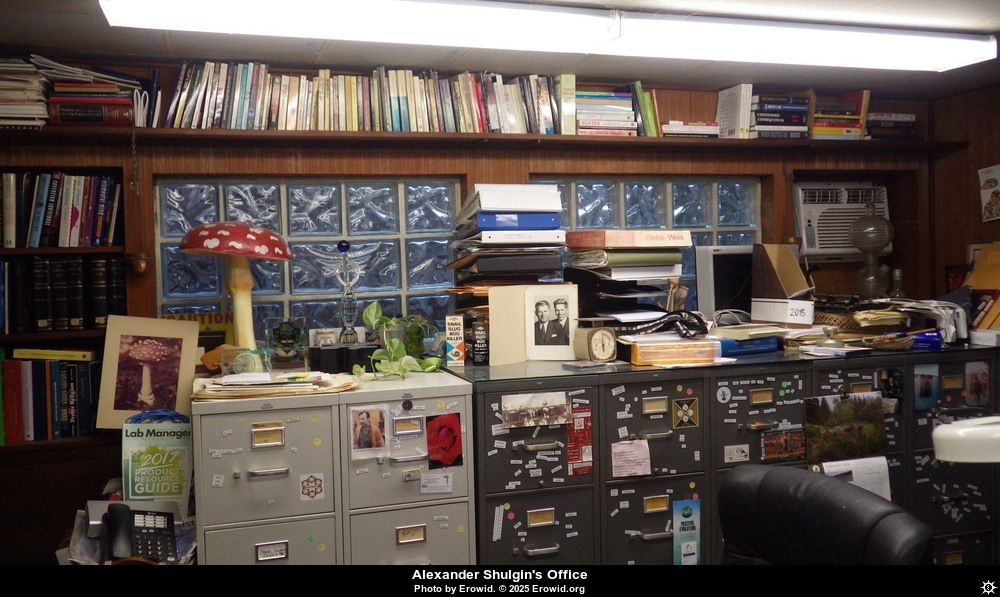
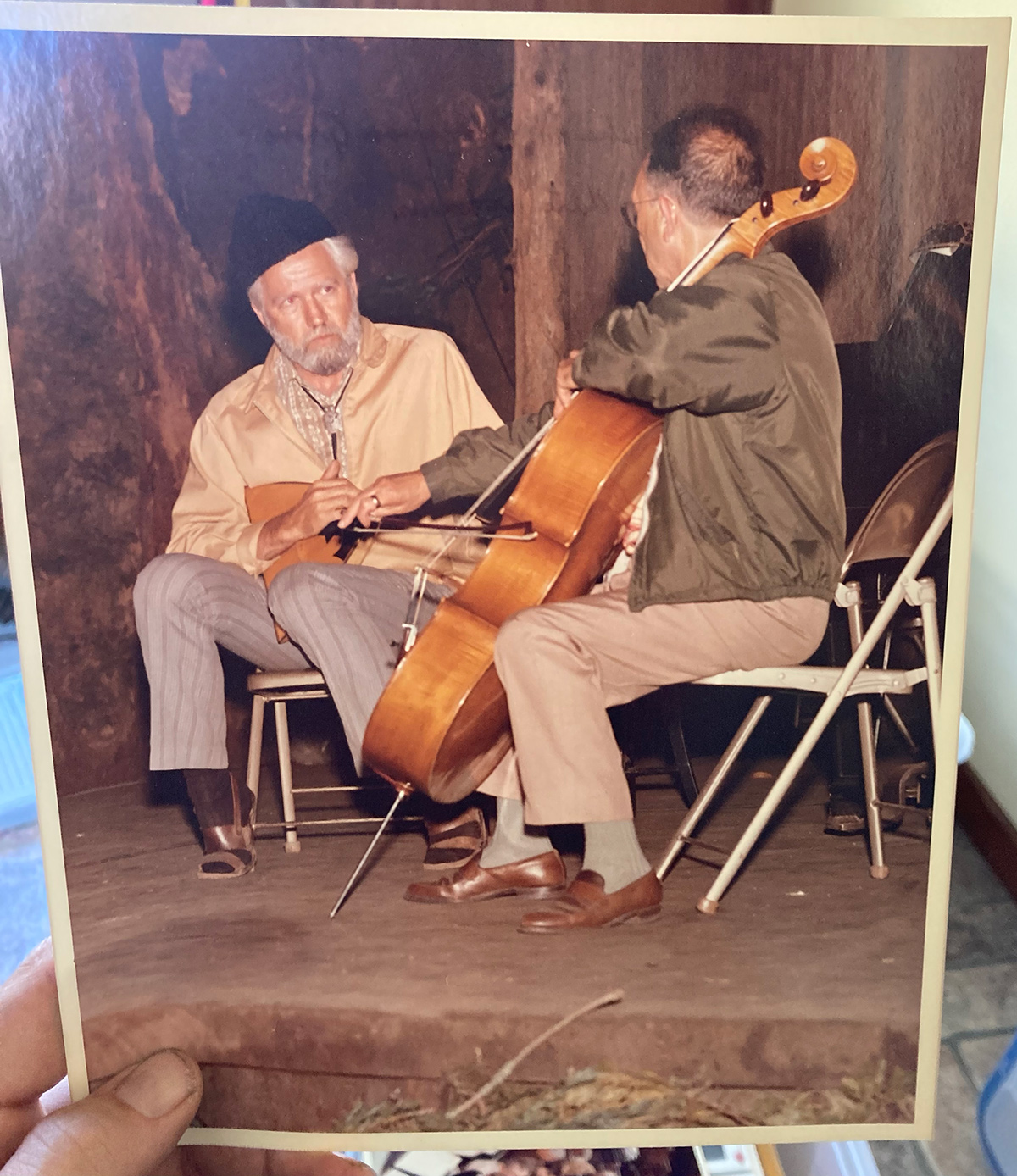
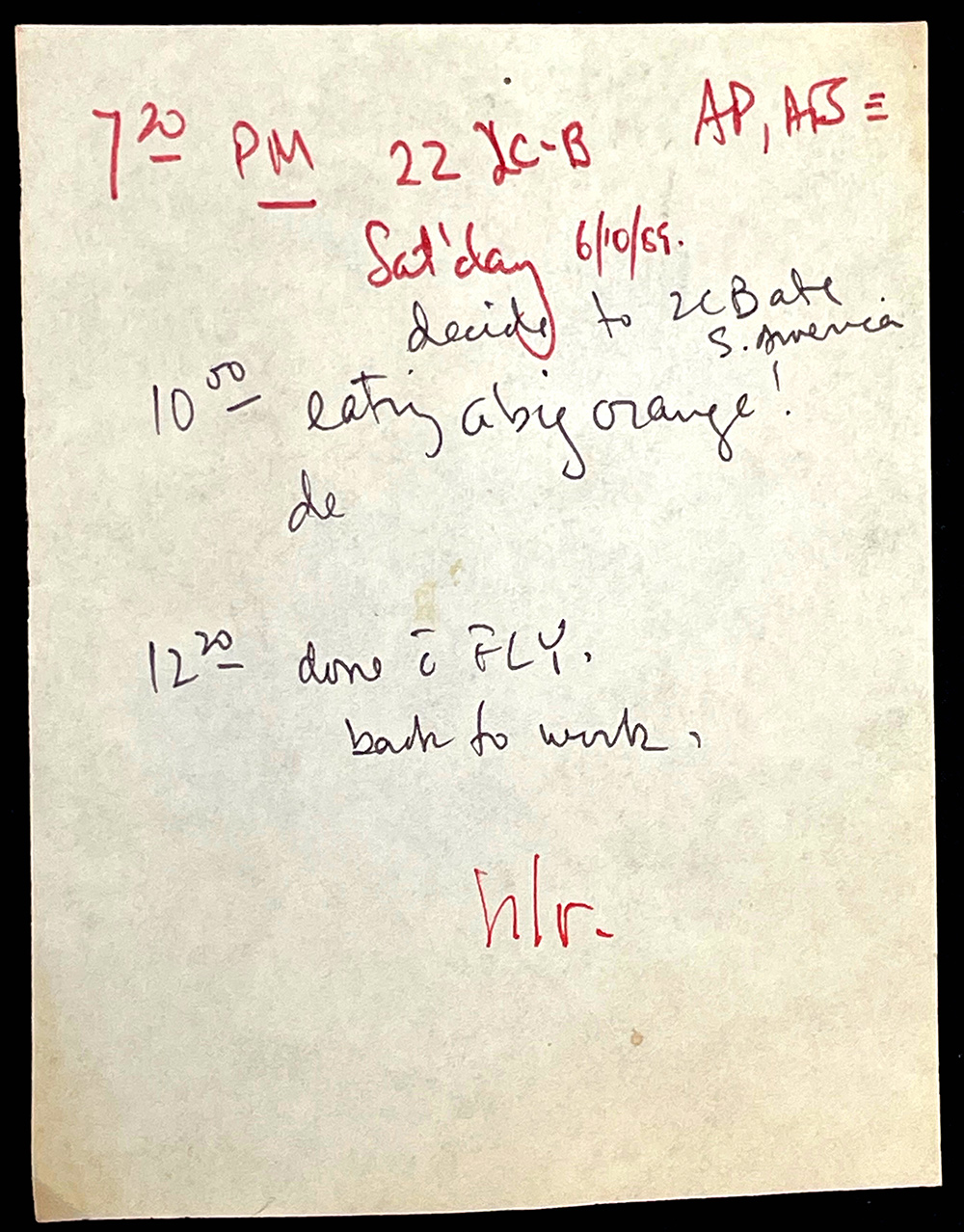
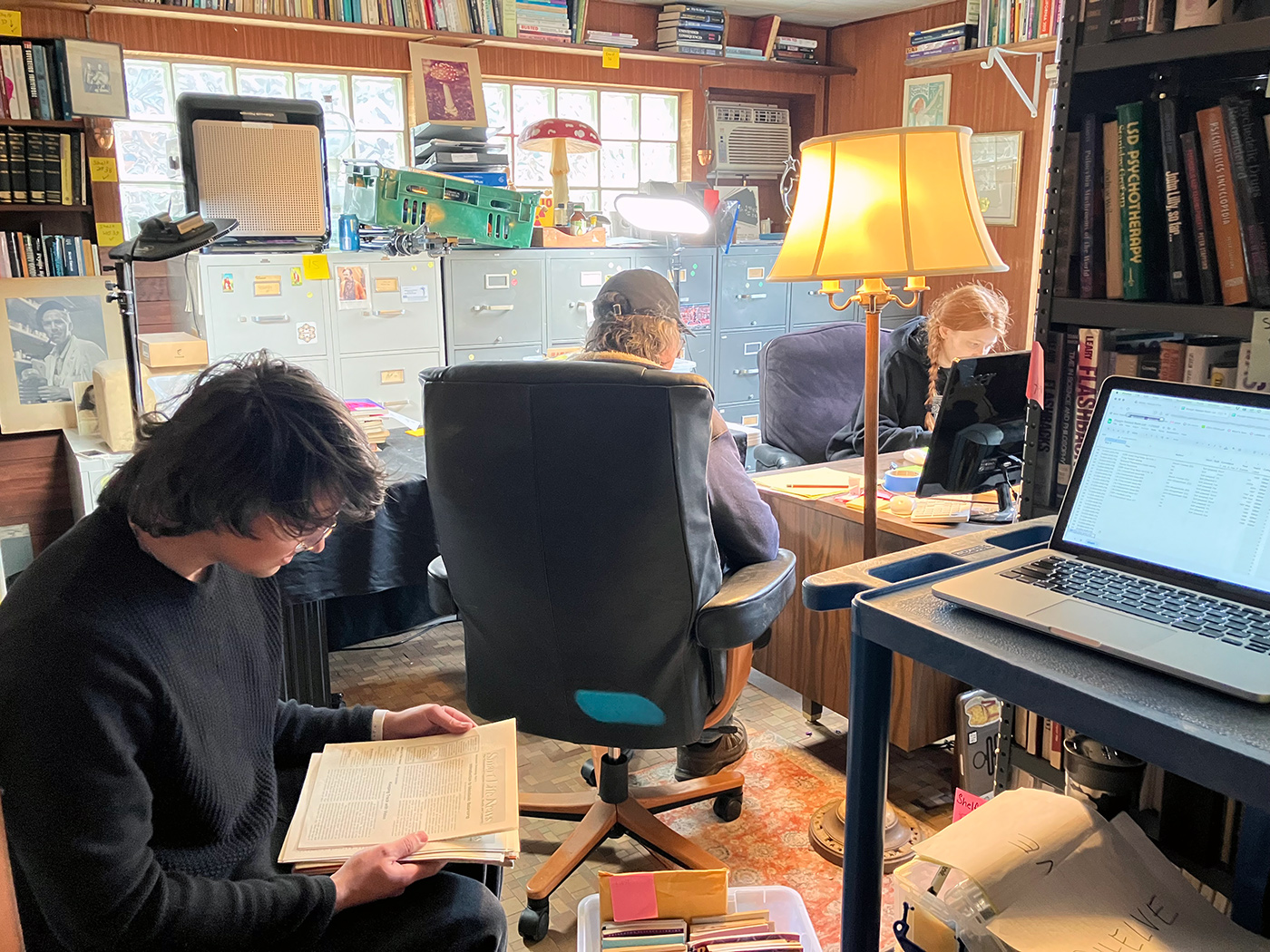
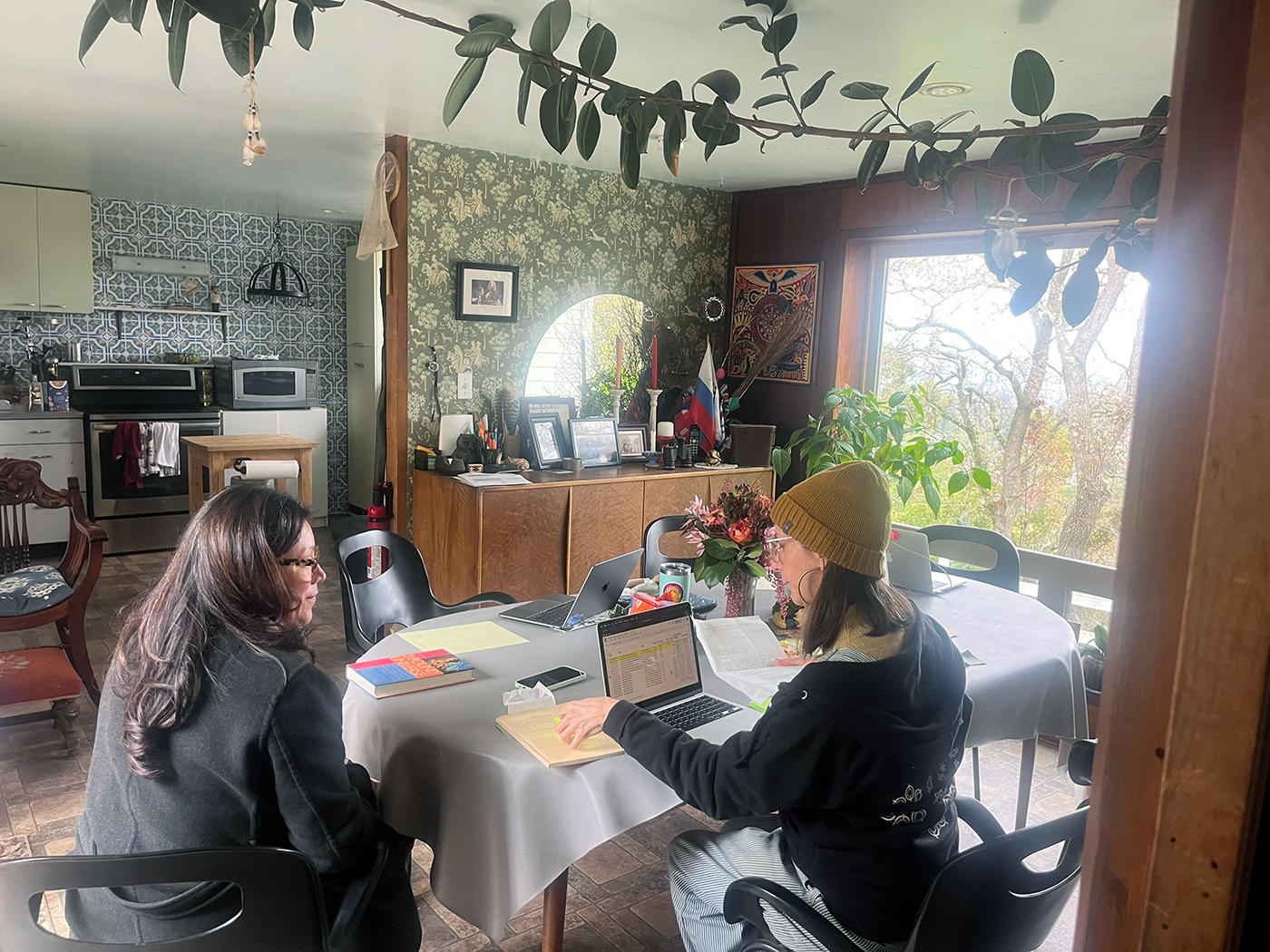
September 2025 – The small but mighty Erowid archiving crew (staff and volunteers) who are cataloging books and documents at the Shulgins’ Farm finished going through another motherlode: Sasha’s office bookshelves. Besides books and lab notes, Sasha’s shelves hold unpublished manuscripts, collections of writings, and periodicals; coursework, student theses, and manuals; novelties, obscure forensic publications, a nearly comprehensive set of older articles on cannabis research (including the work by Shell done for Edgewood Arsenal), and clippings and photocopies dating back to the 1940s. In the last year, the Erowid crew has inventoried over 4,100 additional items, almost all from Sasha’s office. We documented enclosures (letters, postcards, and notes tucked into books) and unique items for scanning, as well as photographing book covers.

The majority of Erowid’s Shulgin Archiving Collection scanning was completed by the end of 2024, part of a ten-year triage and cataloging phase, when project co-lead Keeper Trout finished scanning all the contents of Sasha’s filing cabinets and boxes of files stored in the Barn. Trout is in the home stretch of scanning select items from the office bookcases, and re-photographing a small number of book covers. Fragile film, video, audio tapes, reel-to-reel recordings, slides and CDs are being professionally digitized in Albany, California. Many of the archive’s photos are securely stored at Erowid Center’s library, as we work to raise the funds to have them professionally scanned. We’ve sent a couple thousand out to test scanning companies, but won’t be able to get the majority digitized until additional funding is found.

As we sort photos and compile metadata about books and documents, we’ll be sharing highlights. Meanwhile, some of Erowid’s Shulgin Archiving crew have shared their thoughts on
the Archive and the experience  of working with the collection.

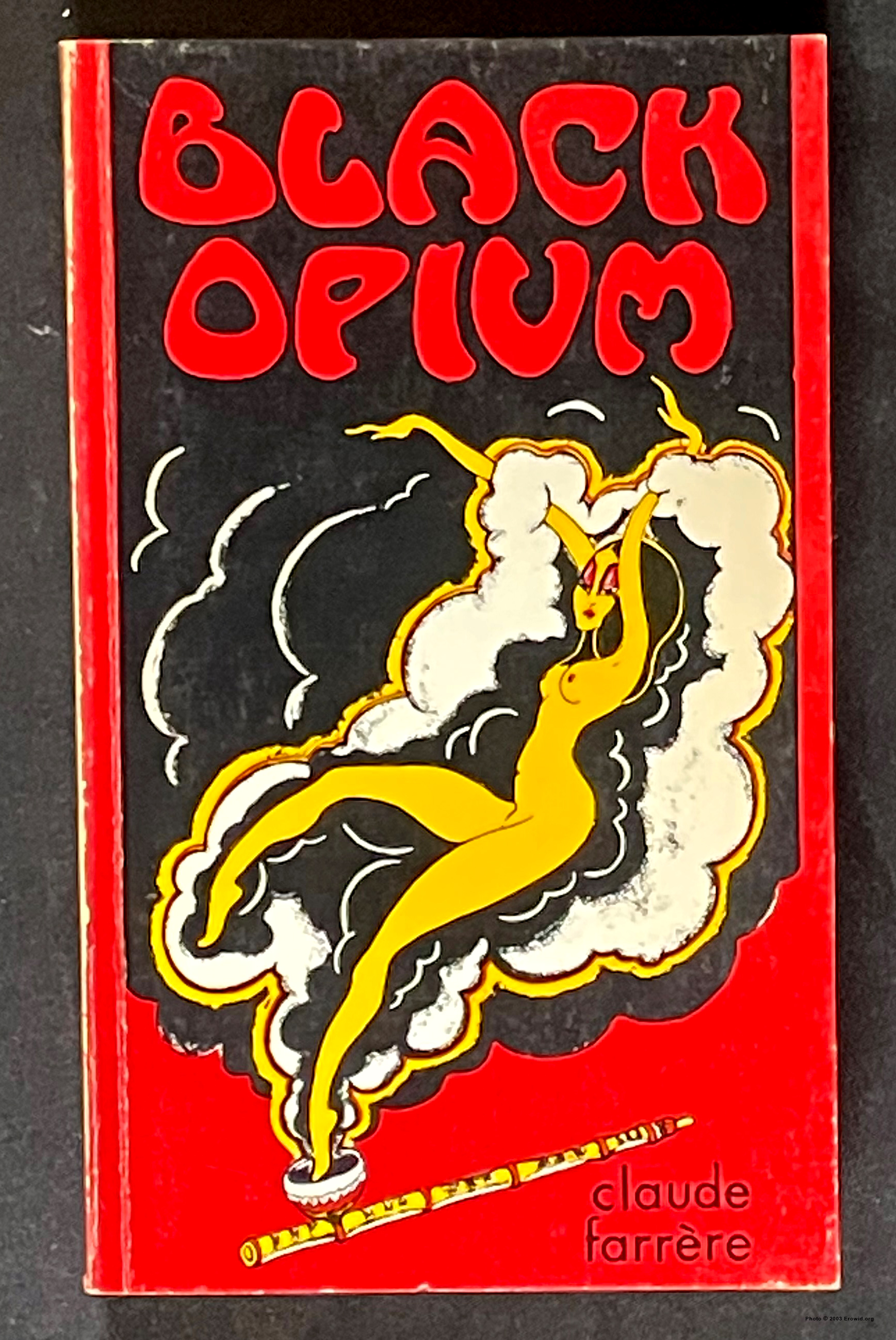
“Volunteering on book cataloging for Erowid’s Shulgin Archiving project has been a great opportunity to create a full accounting of Ann and Sasha’s library. A dusty fun time that lead to some great additions to my own library, as I was able to find some of the interesting titles online to purchase, including a copy of the handwritten and illustrated Alice’s Adventures Under Ground, which was the original title of Alice in Wonderland; the old novels Black Opium by Claude Farrère and Cocaine by Pitigrilli, both with some great illustrations inside; and The Haight-Ashbury: A History, by Charles Perry. And working together with a great group of dedicated people was wonderful!”
— Oliver, volunteer since 2019

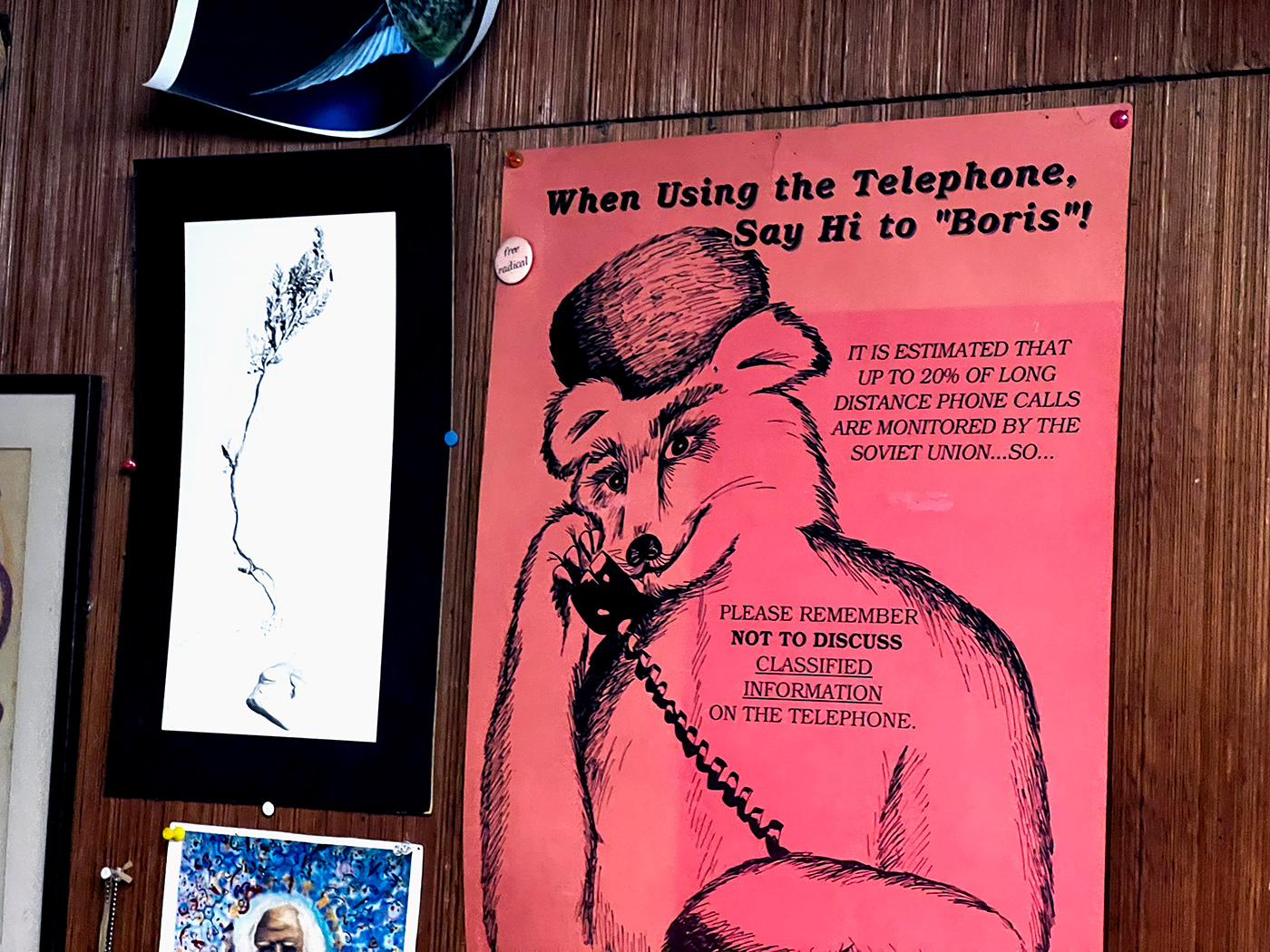
“Sorting through the contents of Sasha’s office was a particular joy. Not only for the incredible contents of his library, but also for the dazzling array of fun and witty posters and memorabilia covering the walls. Two items in particular stand out, both reflecting Sasha’s Russian heritage: a hilarious 60s era cartoon bear wearing an ushanka-hat with a caption admonishing the viewer not to discuss classified material over the phone; and my personal favorite, a handsome photo of doomed Tsar Nicholas II and his son the Tsarevitch Alexi (poor little guy).” — David B, volunteer since 2014

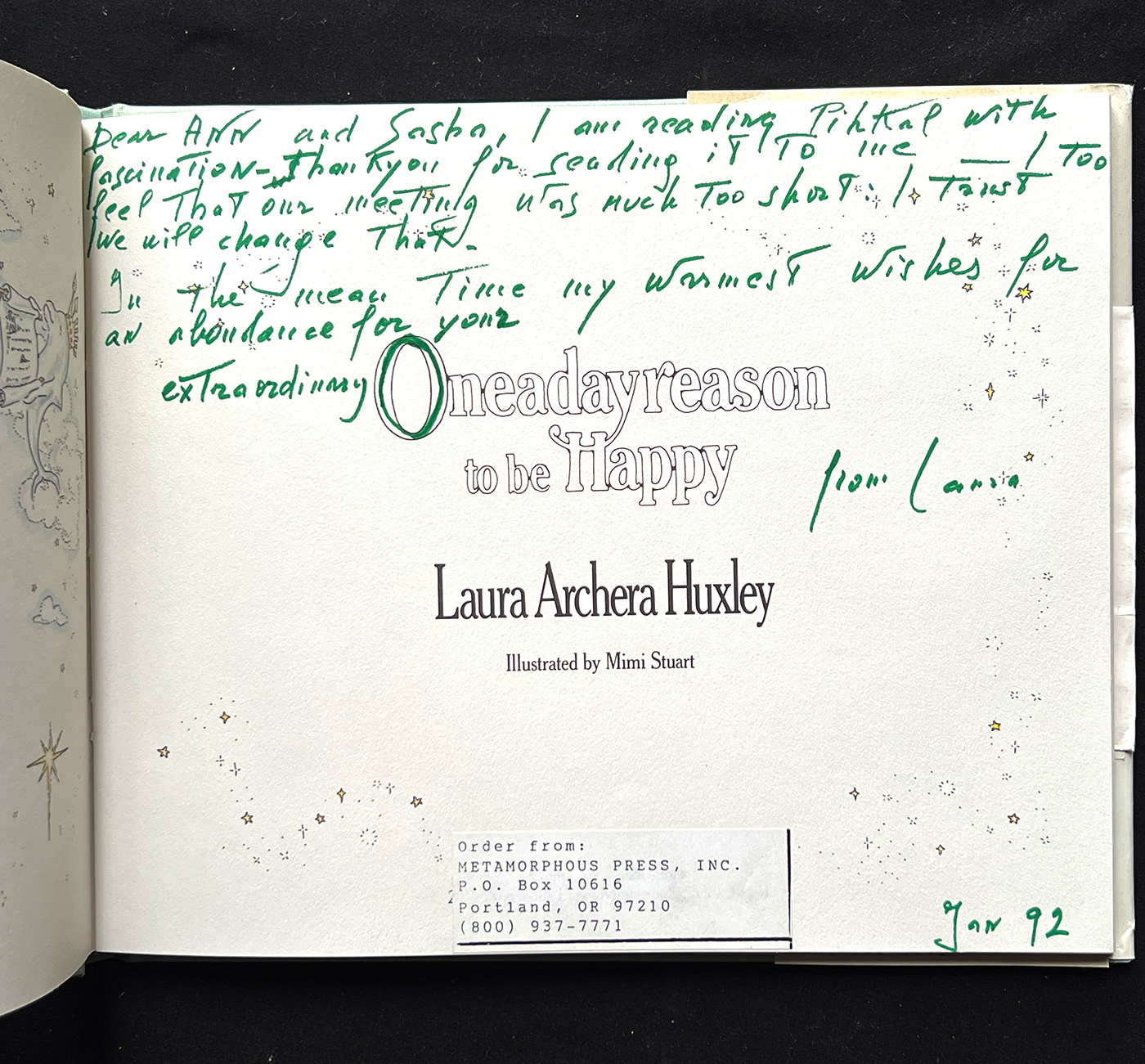
“There isn’t much that can get a group excited about getting up early on dreary winter days, but the mood at the Farm was always high. Though our work was dusty and drafty, it was never dull. Keyboards clicked and clacked at fever pitch, preserving every pertinent detail from the endless torrent of the Shulgin archives. Every so often, there would be a cry: “Inclusion!” A page would be bookmarked, or better still, a passage underlined. These were the moments that most interested me. The Archives are any psychedelic nerd’s dream collection. There are countless beautiful and strange first editions, many of which have handwritten notes for Ann and Sasha from the authors. It becomes very obvious after looking at the Archives how central Ann and Sasha were in the psychedelic underground. They seem to be everyone’s grandparents, with the endless collections of thank-you’s, happy birthdays, and happy anniversary notes to prove it. Even though I couldn’t talk to Ann or Sasha, they were still great at giving book recommendations.” — Alysiana, volunteer since 2025

“In anticipation of volunteering on Erowid’s Shulgin Archiving project, I expected to become familiar with Sasha’s library in a data-oriented way, but what ended up happening was that I got to learn about him as a human being with many interests and a soul beloved by the wonderful community he created.”
— Fiona, volunteer since 2025

“Being a part of this project felt like I was getting a glimpse into history. Getting to sift through endless pages of molecular formulas in Sasha’s handwriting nearly brought a tear to my eye despite barely understanding them. I remember finding a book that was noted as required reading by legendary underground guide Leo Zeff, and feeling like I had found a true treasure. However, my favorite part was being amongst a group of dedicated individuals who were always willing to share some knowledge or a funny story. The range of material catalogued was truly impressive and I hope that there are continued efforts to preserve and eventually share what the Shulgins collected over their lifetimes.” — Veronica L., volunteer since 2024

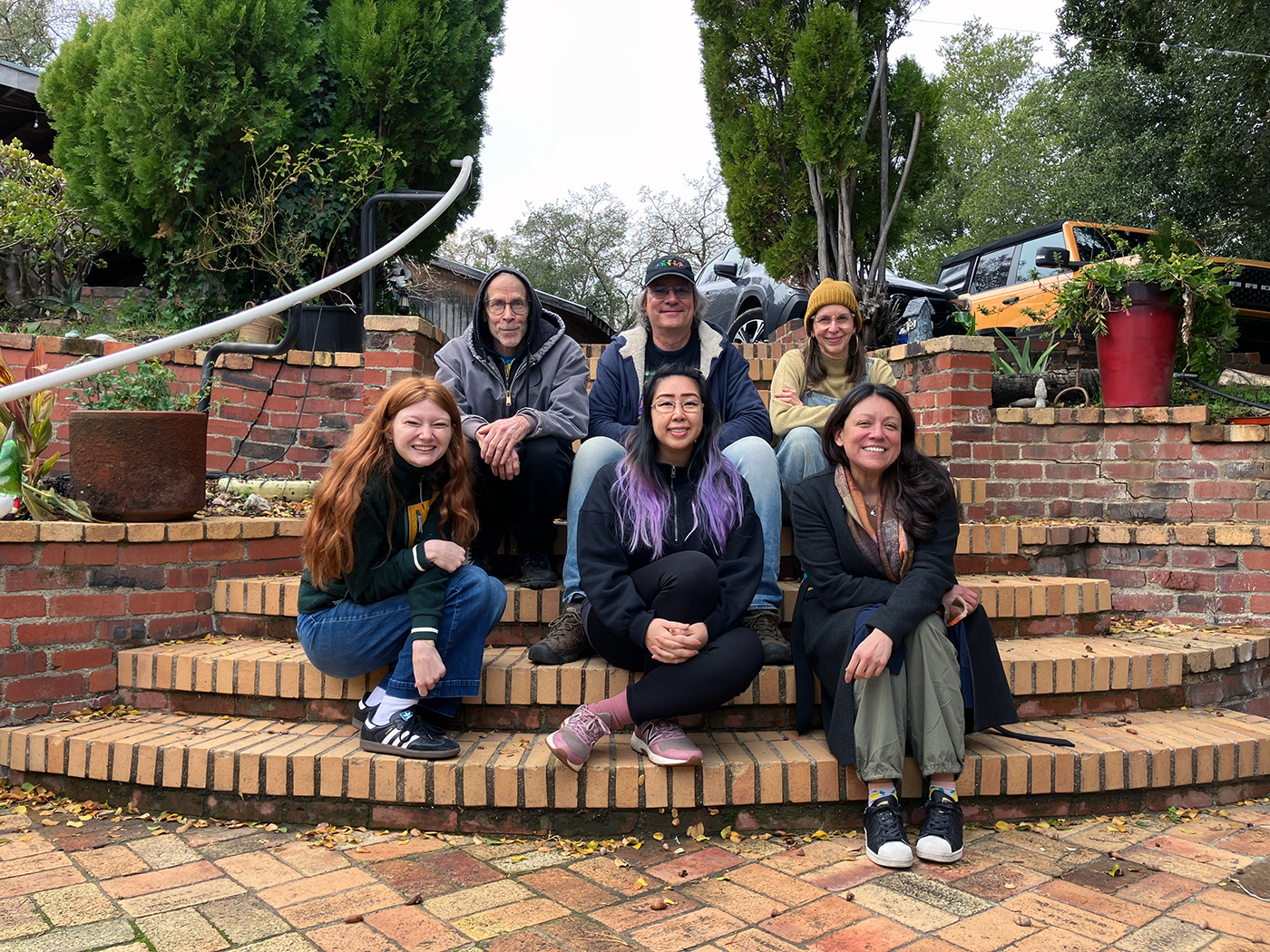
Some of Erowid’s Shulgin Archiving Crew – Trout, Oliver, Sylvia, Alysiana, Fiona, and Veronica (photo by Dudleya)
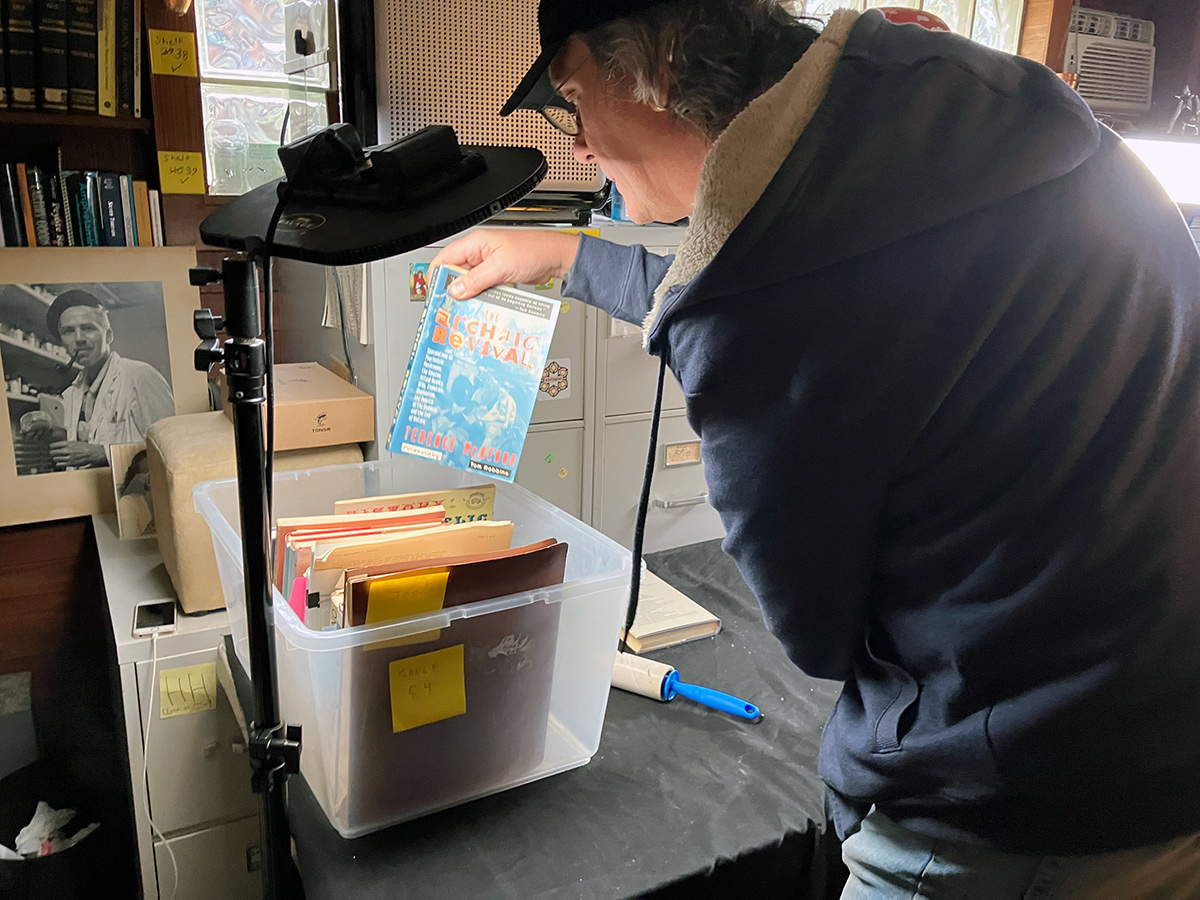
Oliver at the photographing station (photo by Erowid Crew)
Flamingo, Oliver, and Alysiana in the Office (photo by Sylvia)
Veronica and Sylvia cataloging in the Kitchen (photo by Alysiana)
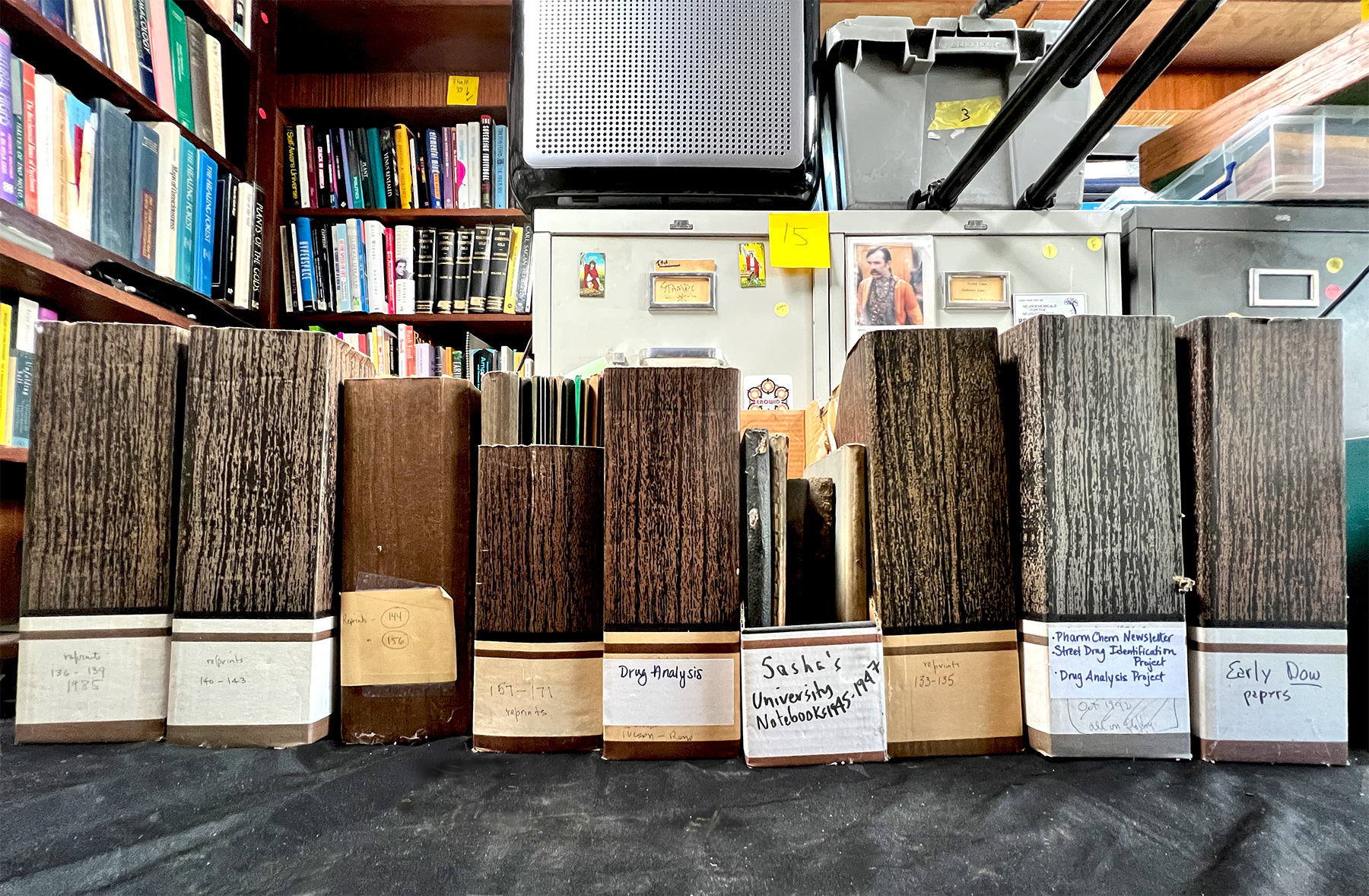
Shelf organizers from Sasha’s office (photo by Erowid Crew)

September 2024 Shulgin Archiving Update

Erowid is in the final stretch of digitizing and cataloging the documents, books and other media that are part of the Shulgin Collection. So close!

The most recent multi-day volunteer gathering held at the Farm to catalog books, scan anything tucked into books, and go through everything with fine tooth combs was held on September 12-14.

We’re still finding stray bits and pieces here and there: an overlooked box in a closet, an envelope that had slipped behind a desk, a photo in an unexpected place, but the part that involves scanning Sasha and Ann’s papers is 99% finished.

Two of the last steps in the archiving plan of action were started this month: 1) Cataloging Sasha’s psychoactive drug-related books and anything else on the shelves of his office, and 2) Inventorying and digitizing audiovisual and other media, which one volunteer has dubbed “anachronistic media” — the glass slides, VHS tapes, undeveloped film in odd formats, and out-of-date digital storage media of various sorts (remember Zip disks?). We’ve already catalogued all the off-topic books and some of the industry periodicals and scientific journals, a process that took hundreds of people-hours.

Compiling metadata about each item is crucial, and this process is parallel and ongoing. This involves sorting through a scan and figuring out what the thing is, keywording, summarizing, marking what needs to be redacted for privacy prior to making available to the public, etc. We’ve categorized and added metadata for 75,000 out of 200,000+ scanned Shulgin documents so far!

The most exciting part has been uncovering gems as we go through every piece of material. We loved one photo that Keeper Trout found, of a neuroscience meeting from 1968 at MIT about “psychotomimetics”. How times have changed. But what an amazing cast of characters, for the history buffs.

1968 Neuroscience Meeting at MIT

Much more to come, with the help of contributors and volunteers. We also are stalled on a couple of fronts due to budget constraints, notably the photo digitizing, which must be outsourced.

Thanks to everyone and, of course, to Sasha, Ann, Wendy, and the rest of the family for making it possible to get to this point.

DrugsData News – Administrative Pause Explained

April 7, 2025 — One year has passed since our lab was ordered by the DEA to halt analysis of DrugsData samples and re-apply for exemption. We have no updates to report, and all details below still apply. Timelines on DEA decision-making are long; our hope remains that this new application is still under review.

September 25, 2024 — On April 10, 2024, after 23 years of continuous service as the only program offering anonymous mail-in lab testing of controlled substances in the United States, DrugsData went on pause. Our lab was ordered by the DEA to halt analysis of DrugsData samples and re-apply for our exception to the rules that disallow anonymous testing and the shipping of samples of possible controlled substances through the mail without a DEA license and specialized government forms.

lab pipette

As of September 24, 2024 we don’t yet know what caused this situation or have any real understanding about when or whether Erowid Center’s DrugsData project will be able to re-start. We’re disappointed in how long the process is taking, but we continue to be hopeful!

It is our express long-term goal for DrugsData to catalyze a shift toward allowing more labs across the United States to anonymously analyze samples from the public. The DEA is notoriously private about their internal processes, more so than many other federal agencies. They did tell us that they are trying to create a process for re-approving our project that they have not previously had, which adds to our hope.

One complication is that it is is our partner lab that has the DEA license, approval, and waiver of 21 CFR 1305.03(c), not Erowid Center. So Erowid isn’t in the ideal position to complain or press for answers. We made the decision to remain hopeful and not say anything publicly that would prompt public pressure that might annoy DEA officials. We are aware that our response to this situation could endanger our lab’s long-term relationship with the DEA, which we don’t want. A good-faith relationship is required for any controlled-substance testing lab to exist. If we do this wrong, we endanger the lab (our long-time partner), not Erowid Center.

Since early April, we’ve told the public that the project is going through “administrative red tape”, which summarizes the situation without going into too many details. But now that our annual September Drive is underway, we can no longer simply demur. Many Erowid supporters obviously have questions about what’s going on with our DrugsData project. So this is the first time we’re describing in more detail what has been going on.

We don’t think the program was stopped because of any suspicion of criminal activity or investigation into DrugsData. The implicit rules are that we do not violate the spirit or letter of the 1973-1974 regulation covering this topic. You can find the full entry (assembled into a PDF with the first page being the scanned pages of the Federal Register, and then the rest being an easier-to-read version of the same text) here:
https://www.erowid.org/freedom/law/federal_register/federal_register_anonymous_testing_rule_1974.pdf

The rule became binding in 1974. It’s a little long, but here is a particularly relevant section:

(f) “The delivery of such substances to a registered analytical laboratory, or its agent approved by DEA, from an anonymous source for the analysis of the drug sample: Provided, The laboratory has obtained a written waiver of the order form requirement from the Regional Director of the Region in which the laboratory is located, which waiver may be granted upon agreement of the laboratory to conduct its activities in accordance with Administration guidelines.”

The waiver mentioned in that paragraph is the waiver that our lab has received three times over the past 30+ years. The first was in 1988, the second was when we started EcstasyData in 2001, and the third was when the lab changed ownership in 2016. During the previous two re-approvals, the process took about six weeks, during which anonymous testing was not halted.

In contrast, over five months have passed since the latest application for re-approval was submitted.

Our hope is that DEA will see that we’re involved in important research projects designed to monitor street drugs and offer health agencies more insight into street drugs and the opioid crisis. At least one state Department of Public Health believes that our work, as part of a large team, has provided on-the-ground benefit to health care providers and end users. County officials continue to value the lab validation of on-site testing technologies, as well as the direct access their staff has to the results from their area, and from around the United States.

The pause on DrugsData testing is hurting research. It is actually causing harm to real people who are less able to learn about the contaminants in the drugs they consume. Stopping our project also hurts medical professionals and city-, county-, and state-level efforts to reduce harm through drug supply monitoring.

Other groups in the United States are doing lab drug checking as part of research projects and street drug harm reduction, many of which we collaborate with. Sadly, none accept samples from the public by mail. We like these groups a lot and would like to promote them, but in the context of describing our DEA issues, we’d prefer to not mention their names. We’ll save that for another update. The progress towards ubiquitous local drug checking in the United States over the last five years has been absolutely amazing, and we’re glad to continue to play a role in it, even while our own project is in limbo.

Thanks to everyone for their support of DrugsData and Erowid Center, and your patience during this long process.

Shulgin Archiving: What’s the Metadata?

— By The Erowid Crew

We have made tons of progress on the Shulgin Archiving project.

We are very close to being done with the digitizing process. Practically speaking, all paper documents have been scanned: over 250,000 unique documents. The final count will be complete once we finish “the Metadata Process”, since some of the scan PDFs contain multiple documents and there will be some duplicates to remove.

The Metadata Process involves indexing and categorizing all the documents. The first pass requires trusted members of the Erowid Crew to review each scanned file and record the document type, date, author, title, keywords, and a brief description. But the most important part of this first pass is reviewing each document for privacy concerns.

The Shulgin Archive includes a complex mix of document types, including private communications that describe illegal activity, medical records, checking account ledgers, and receipts. Many items have no privacy concerns, some will require redaction before sharing, others need to be embargoed for a period of time, and some should never be part of any archive. As of September 2023, the Erowid Crew has created first-pass metadata entries for 50,000 PDFs.

As of September 2023, the Erowid Crew has created first-pass metadata entries for 50,000 PDFs.

One of the last sets of materials left to be digitized is the Shulgins’ collection of approximately 40,000 photographs. This has been held up due to the the cost of professional scanning, but we’re hoping our 2023 September Drive will raise enough financial support that we can begin high-resolution photo scanning in October or November 2023. In the meantime, the photos are being stored in a temperature-controlled, secure location. For more about the Shulgin Archiving Project and its funding needs see our September 2023 Update PDF

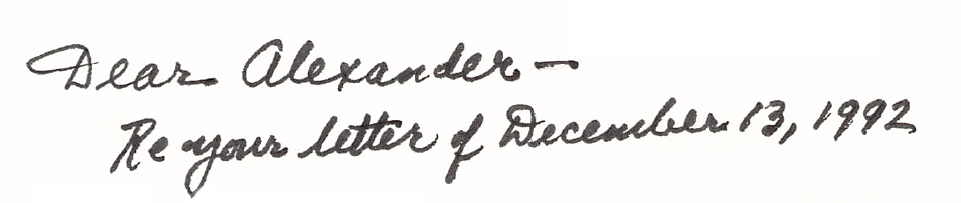
Despite not yet being able to share the full collection publicly, we’ve picked out a few documents to spotlight. The first example is an untitled page of writing by Alexander Shulgin, circa 2007. It was scanned out of Sasha’s office’s main filing cabinets, from Cabinet 6, Drawer 2, in a hanging folder labeled “Papers in Press / Being Written / Thought About”: Untitled “Many, many years ago… “

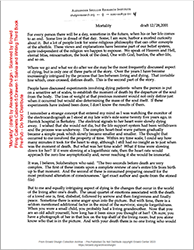
There are lots of interesting pieces. A draft Sasha wrote in December 2001, obviously intended for what Ann & Sasha called “Book Three”— meaning the third book in their PiHKAL, TiHKAL, and ?iHKAL trilogy—muses about mortality and death, with some highly personal elements, a signature feature of their P/TiHKAL writing style. It contains some beautifully relevant thoughts on what will happen to Sasha’s “strange collection” of stuff: “Mortality” (draft 2001-Dec-28) .

The third example is a gem that we can thank Keeper Trout and Tania Manning for finding. Rather than organizing all of his correspondence in his filing cabinets or in his various “basements”, Sasha saved some written communications tucked in the pages of books they were related to. After realizing this, Trout conducted an exhaustive search through the pages of all the books shelved in Sasha’s office. A letter from Richard Evans Schultes was found in a copy of Schultes’s Where the Gods Reign: Plants and Peoples of the Colombian Amazon (1988). The content is curious, not super important, but a hidden treasure nonetheless: Letter from R.E. Schultes to A.T. Shulgin (1991-Nov-13) .

We are looking for more people to help with the Shulgin Archive, though we promised Ann & Sasha personally and contractually that the first-pass privacy review would only be conducted by people with whom we have an established relationship of trust or who were close to the Shulgins. We will soon be looking for people to help with the second pass of the Metadata Process. Let us know if you’re interested in helping get the collection in shape for public display.

And please consider contributing to Erowid’s 2023 September Drive so that we can get the photos scanned!

What is Ketamine Precursor A?

It’s been noticeable that most (nine out of ten) ketamine samples analyzed by DrugsData since March 2019 have contained 1-[(2-Chlorophenyl)(methylimino)methyl]cyclopentanol (CAS #6740-87-0), or “Ketamine Precursor A”. Synonyms of this substance in the literature include “Ketamine Related Compound A” and “Ketamine Impurity A”.

Since 2019, only 37 ketamine samples have been analyzed by DrugsData that contain only ketamine (zero in 2022). An additional 297 sample contained Ketamine + Ketamine Precursor A, and 19% of these 297 samples also contained MSM.

Ketamine Precursor A has been notably present in black market ketamine, but should not be present in commercial, pharmaceutical ketamine inside the United States or Europe.

Ketamine Precursor A is not considered harmful, just a waste of mass and chemical. We do not know of any good research on its toxicity, but unfortunately, most drug research that shows “no effect” doesn’t get published. If it were super toxic, we’d probably know about it.

A subreddit has covered this topic: https://www.reddit.com/r/AskDrugNerds/comments/e6iz5r/any_info_on_ketamine_impurity_a_and_whether_or/

We don’t know anyone who has tried it on its own, but it’s unlikely to be active within 10x the dose of ketamine. Just a boring contaminant.

If you have any insights to contribute about Ketamine Precursor A, please let us know, info(at)drugsdata(dot)org.

Shulgin Archiving: A Requiem For Marty

The Erowid Crew has been making a lot of progress on the Shulgin Collection archiving project. There is still scanning and digitizing happening, but the majority of Erowid person time right now is on the preliminary “metadata” step, where each item is quickly looked at and assigned a document type, name, date, and evaluated for privacy/redaction. More about this soon.

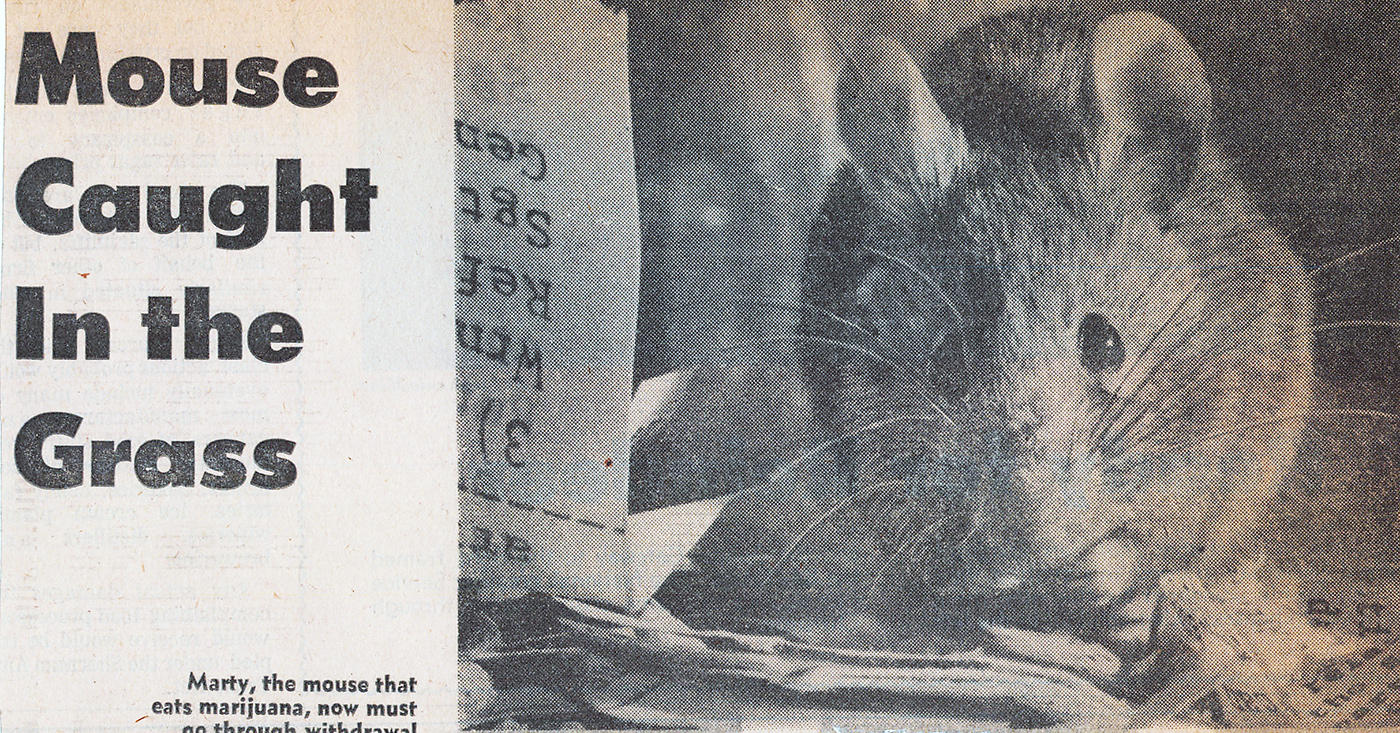
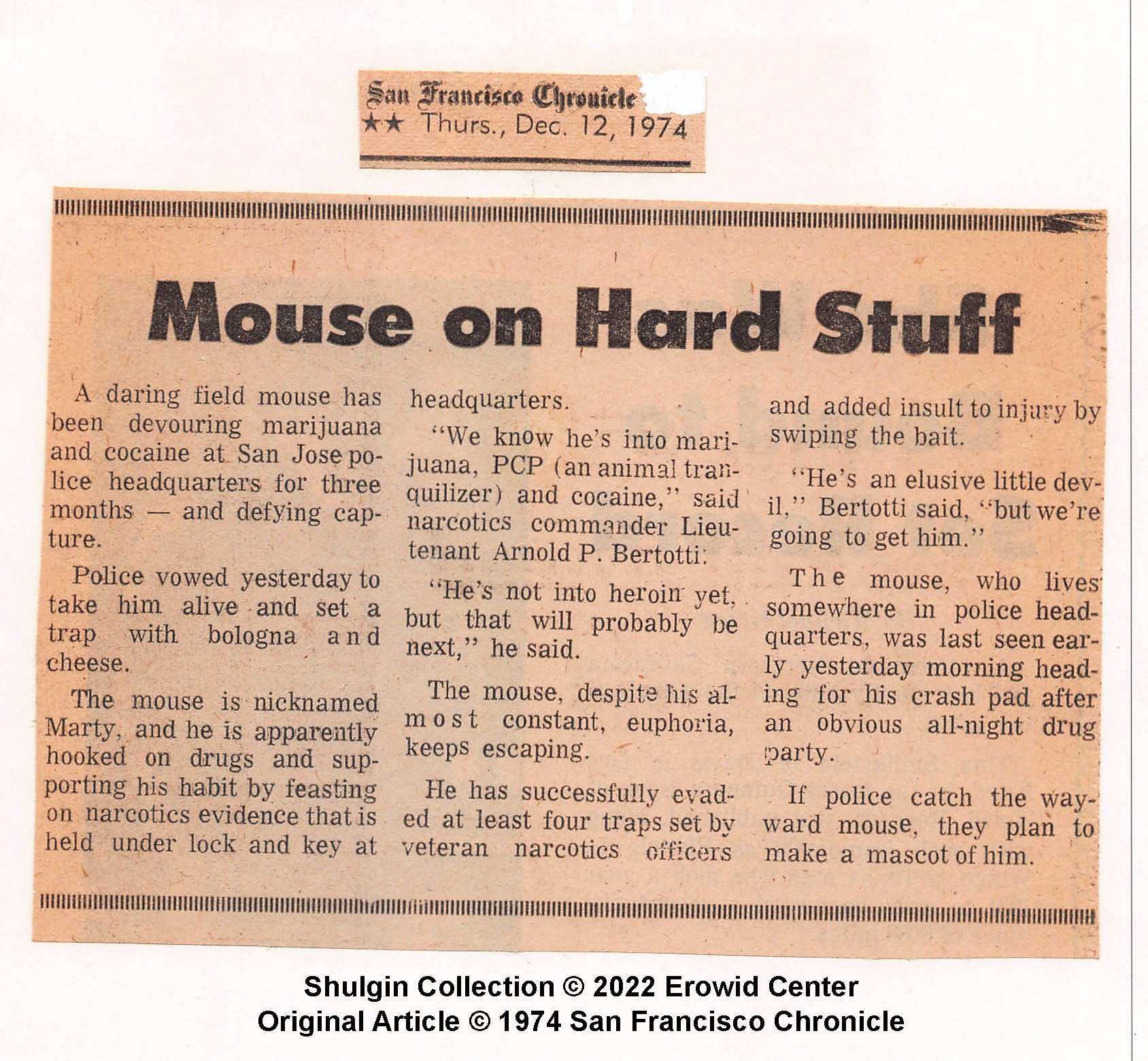
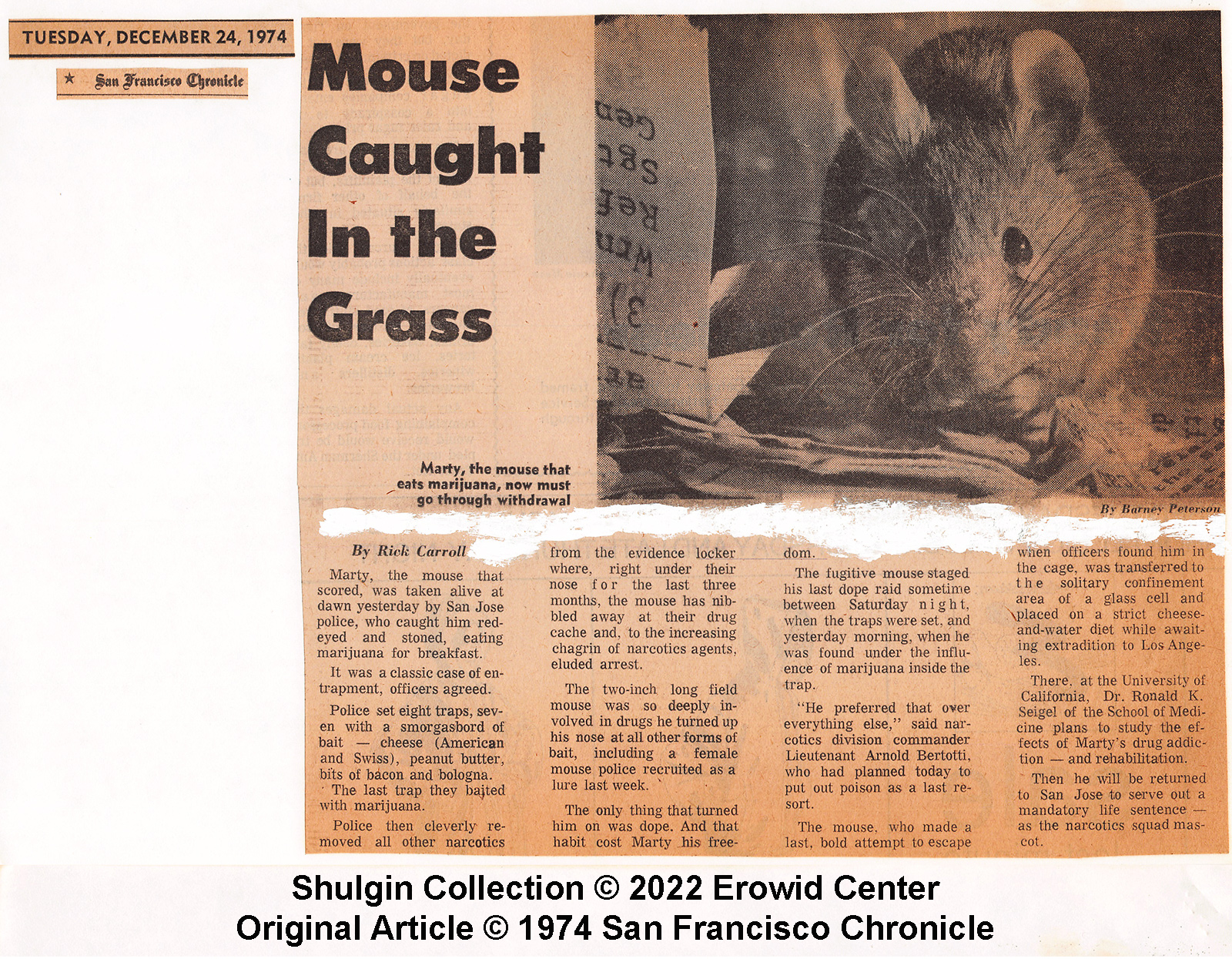
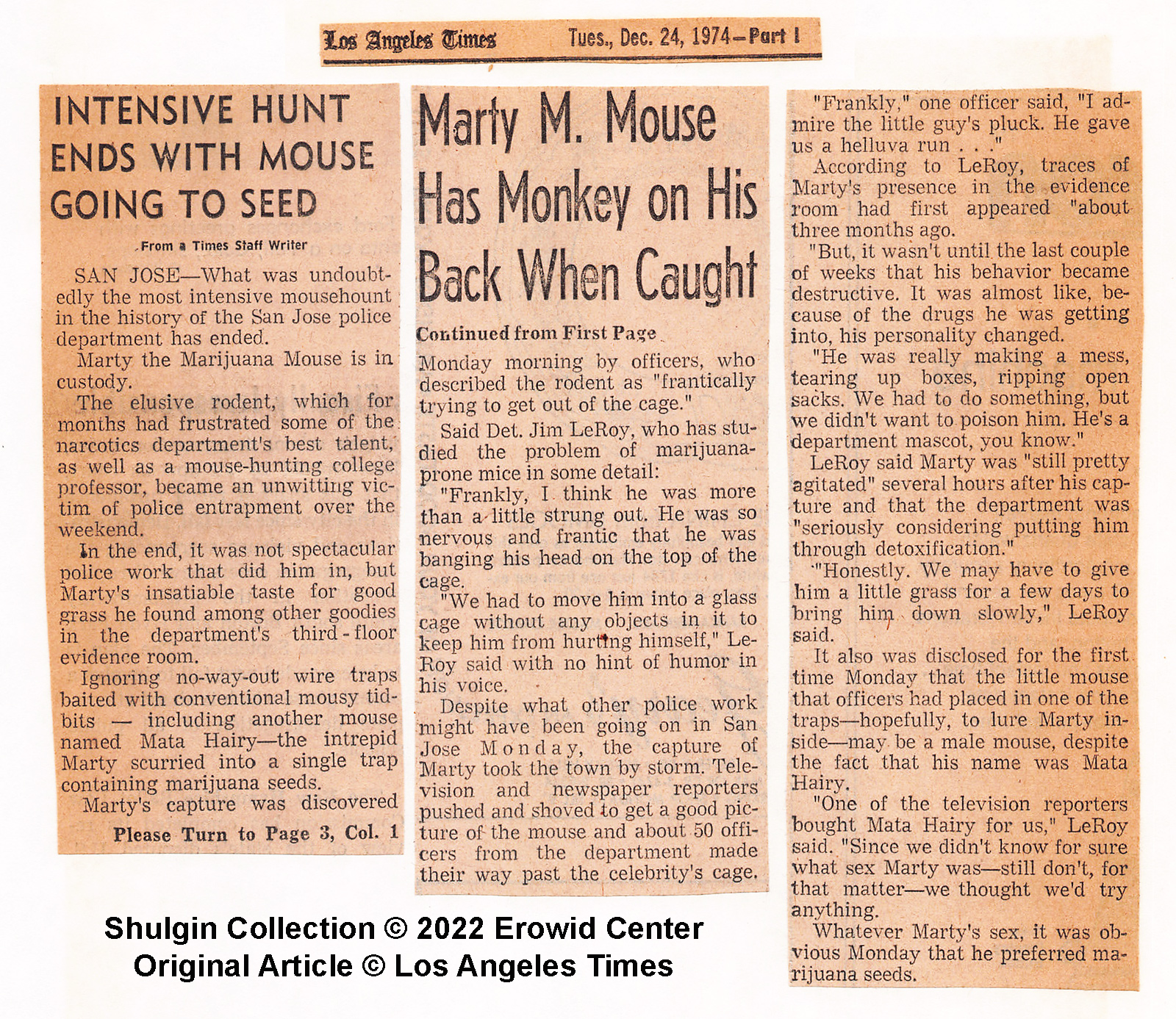
While metadataing, Trout came across a series of news clippings Sasha saved in 1974. Trout felt compelled to write the following requiem. It’s interesting both for the weird story told in the “news” series, to show Sasha’s meticulous collection of articles about psychoactives he found interesting, and to document the way the San Francisco Chronicle and Los Angeles Times covered it. Enjoy :]


A Requiem for Marty
by Keeper Trout, August 2022

Marty never had a chance. He had the might of the San Jose police department out to get him. Ideally alive but it was not required. They had tried everything. Even going so far as to use sex to lure him into a trap. Nothing had been working to catch the elusive rodent. Few mice can say that they’ve eluded the police for months and have also found themselves discussed in multiple news articles.
Marty’s crime was portrayed as being a drug addict but we never were able to learn Marty’s true relationship to drugs. Calling him Marty the Marijuana Mouse, suggests a preference for cannabis. Clearly he liked weed and had apparently sampled cocaine and PCP. At one point it was suggested that he was going to move on to heroin but we would have heard about it if he had done so.
Eventually Marty was caught. Not with the hare-brained idea of introducing a female mouse variously said to be named “Mata Hairy” or “Mona” but by removing the drugs from the evidence room and baiting a live animal trap with weed seeds.
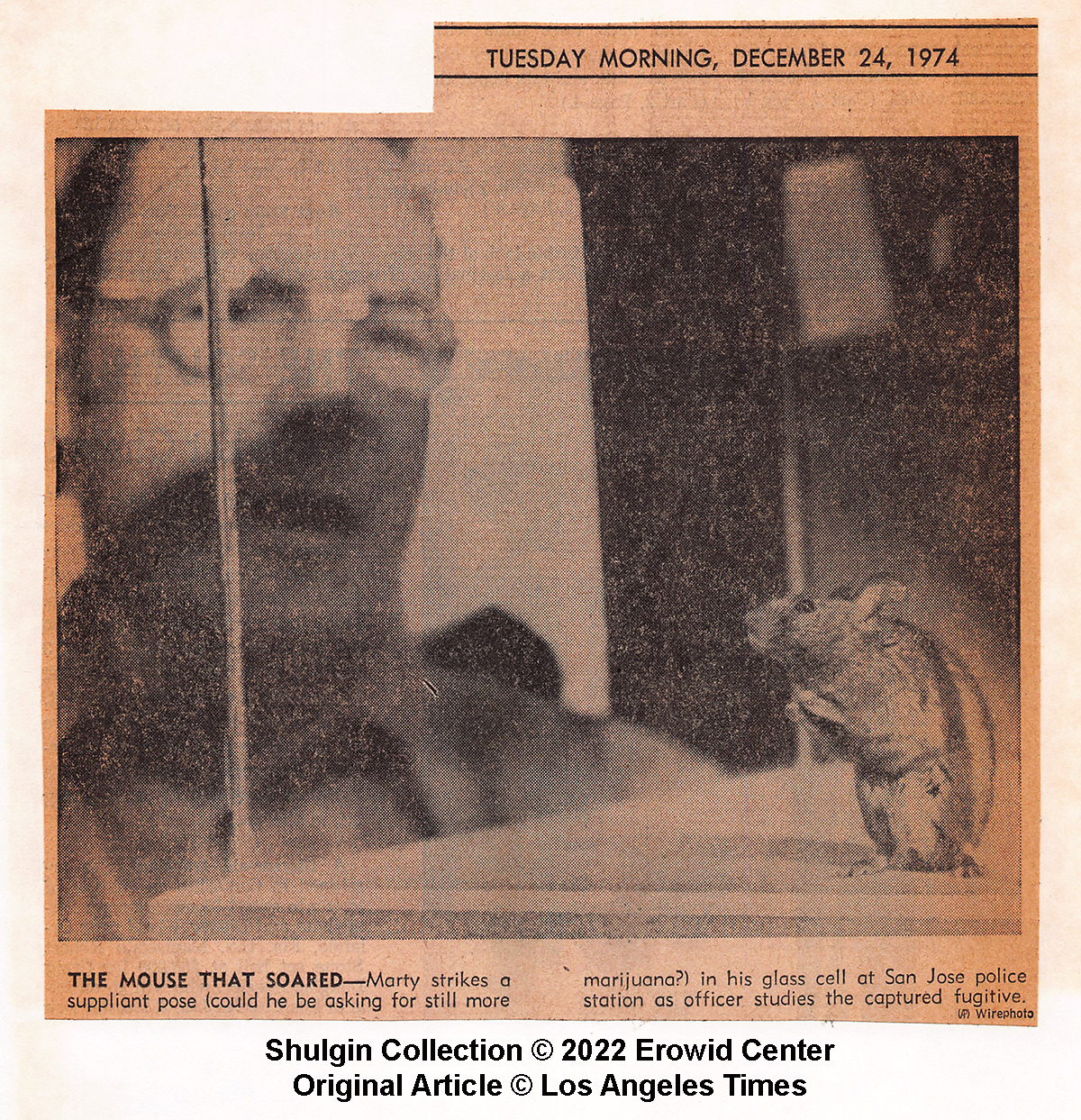
Once trapped, Marty found his behavior ascribed to his imagined drug-deprived mania. It was said he needed to be placed into a glass box containing nothing at all to prevent him from harming himself by frantically trying to escape. One officer suggested they may need to give him a little cannabis to get him through detox.
For the crimes commonly associated with being a mouse, death is a common punishment. Instead, Marty got life imprisonment, following rehabilitation. His detox and rehab were said to be provided by a local college professor but the details of how that was to be done were not made clear.
He was said to be the “narcotic squad’s mascot”; “Marty M. Mouse”. Their very own imprisoned drug-deprived former drug user, serving a life sentence after being booked for “possession of marijuana, use of narcotics and destruction of evidence”.
A snap-trap somehow sounds kinder.
True story.

San Francisco Chronicle, Thursday, 12 Dec., 1974. Mouse on Hard Stuff.
San Francisco Chronicle, Thursday, 19 Dec., 1974. Cops Desperate — A Turn-On for Junkie Mouse.
San Francisco Chronicle, Tuesday, 24 Dec., 1974. Mouse Caught in the Grass.
Los Angeles Times, Tuesday, 24 Dec., 1974. p. 1: Intensive Hunt Ends With Mouse Going to Seed, p.3: Marty M. Mouse Has Monkey on His Back When Caught.
See also https://www.weirduniverse.net/blog/comments/marty_marijuana_mouse/