





















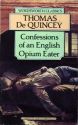

Thomas de Quincy’s Confessions of an English Opium Eater was first published in 1821 in London Magazine, and was later revised and expanded by the author in 1856, although I have not read this later edition, generally considered inferior. The Confessions sparked the imagination and interest of readers at the time and earned for its author some notoriety. Today, the situation is not much different: de Quincy’s work is viewed as a minor classic by the world at large (enough of one, anyway, to merit a Penguin edition with a nice introduction, if that is any indication), and he is something of a father figure among the literati of the drug underground, although I suspect relatively few have bothered to read the Confessions. Nevertheless, it is arguably the pioneering account in the literary genre that consists of taking drugs and writing about one’s experiences and their significance.
de Quincy might be said to have paved the way for the writings of William James on nitrous oxide, Aldous Huxley on mescaline and even the gonzo journalism of Hunter S. Thompson. But de Quincy has nowhere near the stature of Huxley, either as a writer or as a thinker—for good reason. Compared to the Doors of Perception, in which Huxley confidently and brilliantly establishes what still reigns supreme as the best and most mature paradigm for entheogenic drug use, the Confessions is no more than a minor work, the timid speculations of a meek man who never reached his full intellectual potential. de Quincy has surprisingly little of interest to say on the subject of opium-induced visionary experiences, and in order to get at the good bits, the reader is obliged to wade through a morass of maudlin personal reminiscences and overly allusive and indulgent purple prose.
By this I do not mean to dismiss the Confessions as an utter waste of time. It is intriguing to read some early evidence of the decline of western materialism—a fraying at the edges, if you will. Consider, for example, de Quincy’s views on the subject of aesthetics and, more importantly, the construction of reality:
The mistake of most people is to suppose that is by the ear, they communicate with music, and, therefore, that they are purely passive to its effects. But this is not so: it is by the reaction of the mind upon the notices of the ear, (the matter coming by the senses, the form from the mind) that the pleasure is constructed: and therefore it is possible that people of equally good ear differ so much in this point from one another. [Punctuation sic]
Ultimately, however, de Quincy’s Confessions is not a great deal more than a historical curiosity. Most interesting to this reviewer is the contrast between the fate of the opium addict in the nineteenth century and today. de Quincy’s addiction to opium clearly hurt—in the final analysis—the quality of his life. Yet today his lot as an addict to the very same drug would be incomparably worse. This is called “sending the right message to kids.”
Fatal error: Uncaught TypeError: count(): Argument #1 ($value) must be of type Countable|array, null given in /www/library/review/review.php:699 Stack trace: #0 {main} thrown in /www/library/review/review.php on line 699